
More than 2,800 putative class actions have been filed in the United States related in some way to the COVID-19 pandemic, according to our research of publicly available dockets. The most common claims are by consumers for refunds of tuition, services, or experiences; by employees against employers related to workplace safety; and by insureds against carriers related to purported business interruption claims. As the COVID-19 heat map shows below, New York and California saw the most class actions filed of any states.
Background and Methodology
Each year, Carlton Fields publishes a survey of more than 400 in-house counsel, each of whom has responsibility for the management of class actions at their company or institution, spanning more than 25 industries. The data collected in our annual Carlton Fields Class Action Survey presents a snapshot of the ways in which leading corporate legal departments identify, measure, and manage class action risk.
Additionally, given the interest in COVID-19 class actions and the impact of the pandemic across all industries, our recent surveys have also examined class actions related to the COVID-19 pandemic. Since launching our 2022 Class Action Survey two months ago, the feedback has been tremendous — so we’ve decided to take a deeper dive into the COVID-19 class action landscape. The results below provide our breakdown and analysis of COVID-19-related class actions filed in the United States since the start of the pandemic in spring 2020 through mid-February 2022, for companies of all sizes and all industries, based on publicly available electronic state and federal court dockets.
Results and Analysis
In total, we located 2,875 putative class actions filed since the start of the pandemic related to COVID-19. Forget a wave of class actions — this was a flood.
The COVID-19 class action heat map below summarizes this work:
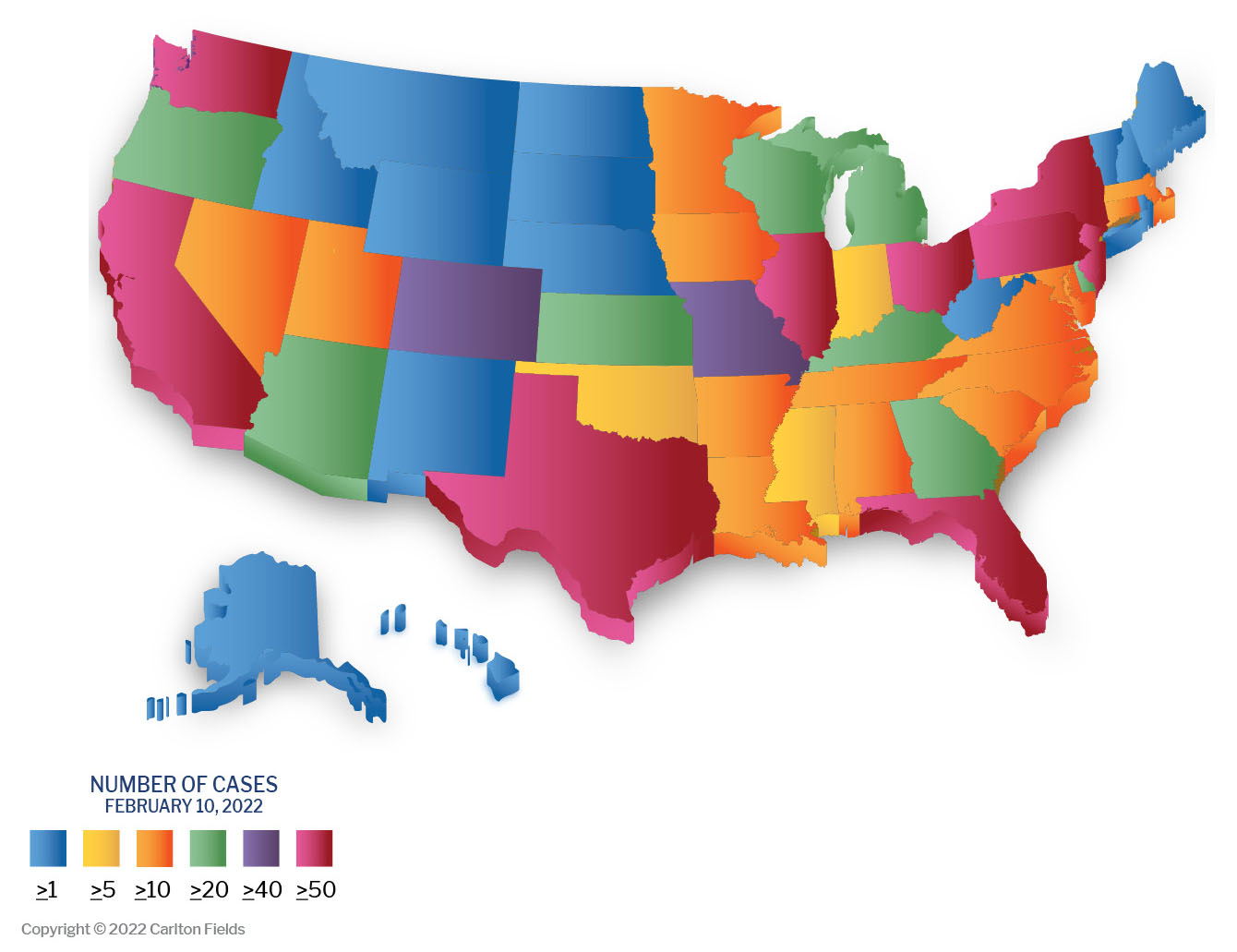
The frequency of filings by state tended to follow population. New York topped the list with 846 total filings, with California a close second at 722. Pennsylvania, Florida, and Illinois each had more than 100 filings.
From our work to compile the map, several other findings of interest also emerged.
The most common claim was for refunds related to changed experiences or circumstances arising out of the pandemic, totaling about 21% of filed matters. Of these, about 14% were claims for tuition refunds in the education industry. The remaining 7% related to entertainment, ticket, and travel refunds and other missed opportunities and events. This category has generally dropped after the first year of the pandemic.
After refund claims, the next most common category of COVID-19 class actions comprises claims by employees against employers, with about 18% of all filed cases. These have taken several forms, from claims for unsafe working conditions due to insufficient safeguards to prevent the spread of the virus, at the one end, to claims related to mandatory masking or vaccine policies at the other end. We anticipate that these will continue. More than half of the 515 putative class actions filed on these issues were filed in California (289), with New York as the next most common state with 61 employment-related filings.
The next most common category involved putative class actions against insurance companies related to purported business interruption claims, with these 401 cases making up 14% of all putative class actions related to COVID-19 that we identified. There are likely more of these cases than what we have captured here, as many are filed in state courts where electronic docket reporting is not readily accessible. These cases have garnered significant attention, with potentially high stakes. Because insurers have overwhelmingly prevailed in these cases, we anticipate that this number will drop as a percentage of new class actions filed. As of now, Illinois and Pennsylvania lead all states with 61 and 58 cases each, respectively. The insurance industry also faced about 43 putative class actions alleging wrongful denial of claims under travel insurance policies.
There were 165 putative class actions filed that were directly related to government action, such as allegations of government “takings” without adequate compensation, restrictions on imports from China, and claims brought by federal workers.
Representing about 5% of cases, there were 148 securities class actions filed since the start of the pandemic related to COVID-19 disclosures, alleging a drop in stock price of public companies. As would be expected for claims of this type, New York and California were the preferred venues, with 61 and 45 filings, respectively.
Below, we show the concentrations by certain types of cases:
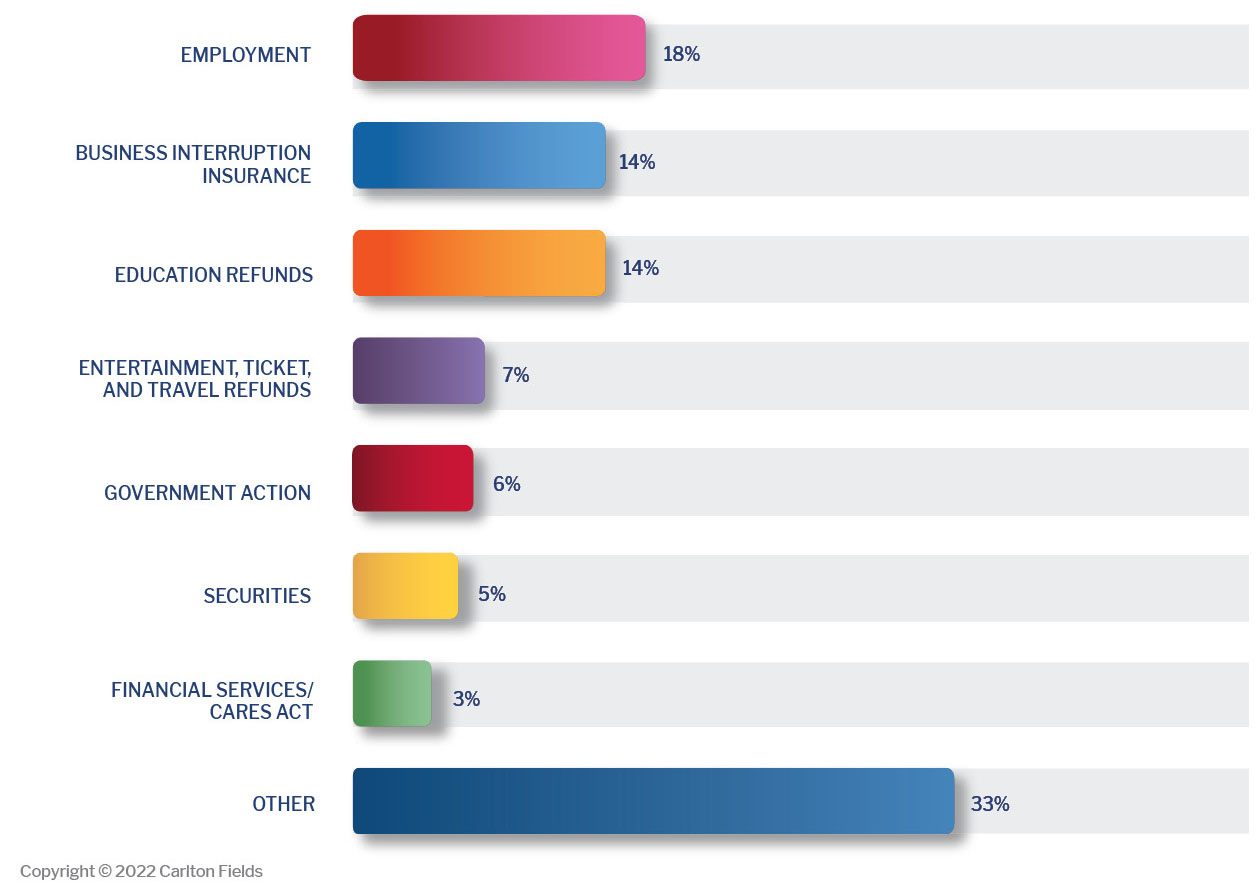
The “other” category includes a variety of consumer claims, such as cruise line negligence (18), general breach of contract (20), privacy claims (61), premises safety (33), product labeling (30), and still others.
A few other findings from our review are worthy of note:
- 62 COVID-19 class actions against airlines, with 14 filed in New York alone.
- 22 putative class actions that alleged COVID-19 price gouging.
- 55 class actions filed by prisoners or detainees related to COVID-19 conditions in institutions.
When read in concert with the survey, we hope that this heat map and analysis provides in-house counsel and class action litigators some sense of where plaintiffs’ counsel are filing these cases and some of the topics of these litigations. Should you have any questions, or to discuss these findings in more detail, please contact the authors of this article.
John E. Clabby is a co-director of the 2022 Carlton Fields Class Action Survey and leads the Securities and Derivative Litigation Practice at Carlton Fields. Julianna McCabe is a former co-director of the survey and leads the firm’s National Class Actions Practice. The authors would like to thank Douglas Evans, a paralegal in the firm’s Washington, D.C., office, for his tireless work in tracking COVID-19 class action filings over these past 24 months.
©2026 Carlton Fields, P.A. Carlton Fields practices law in California through Carlton Fields, LLP. Carlton Fields publications should not be construed as legal advice on any specific facts or circumstances. The contents are intended for general information and educational purposes only, and should not be relied on as if it were advice about a particular fact situation. The distribution of this publication is not intended to create, and receipt of it does not constitute, an attorney-client relationship with Carlton Fields. This publication may not be quoted or referred to in any other publication or proceeding without the prior written consent of the firm, to be given or withheld at our discretion. To request reprint permission for any of our publications, please use our Contact Us form via the link below. The views set forth herein are the personal views of the author and do not necessarily reflect those of the firm. This site may contain hypertext links to information created and maintained by other entities. Carlton Fields does not control or guarantee the accuracy or completeness of this outside information, nor is the inclusion of a link to be intended as an endorsement of those outside sites.
Related Capabilities
Related People
 Shareholder

